
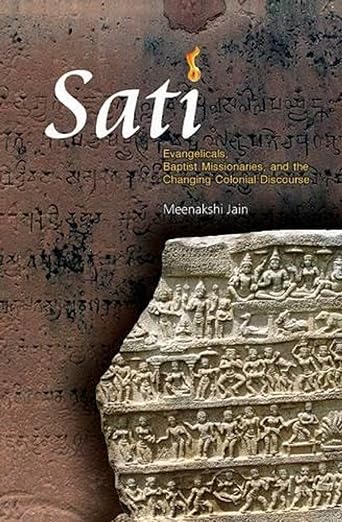
Meenakshi Jain, Sati: Evangelicals, Baptist Missionaries, and the Changing Colonial Discourse. New Delhi: Aryan Books International, 2016. pp. 459. ISBN: 978-81-7305-552-2.
Introduction
Sati is a very painful subject for many Indians. While most people believe that British leaders and Indian reformers like Raja Ram Mohan Roy ended the practice in 1829 to save women, Meenakshi Jain’s book, Sati: Evangelicals, Baptist Missionaries, and the Changing Colonial Discourse, tells a different story. She says that sati was actually very rare and only happened in a few places. She believes Christian missionaries made the problem look much bigger than it was so they could convince the British Parliament to let them spread Christianity in India. The book uses a lot of research to show how the British changed the facts.
About the Author
Dr. Meenakshi Jain is a distinguished historian, author, and academic. She previously served as an Associate Professor at Gargi College (Delhi University). She is widely recognized for her extensively researched books, including Sati, Flight of Deities and Rebirth of Temples, and The Battle for Rama. For her significant contributions to literature and education, she was awarded the Padma Shri in 2020, which is India's fourth-highest civilian award. Dr. Jain continues her academic work as a Senior Fellow at the Indian Council of Social Science Research (ICSSR), focusing on cultural and religious developments in medieval and early modern India. She is a former Fellow of the Nehru Memorial Museum and Library also. Currently, Dr. Jain is a Member of Parliament in the Rajya Sabha.
About the Book
The book, Sati, is a long academic book (459 pages) published by Aryan Books International. It has two main parts that look at the history and the laws regarding the practice of sati in India.
Part A has twelve chapters that follow the history of the subject in order. It starts with ancient writings and ends with the British colonial period. It looks at how British religious groups and missionaries influenced the decision to stop the practice in 1829 and how Indian people reacted to that change.
Part B is a collection of reports written by foreigners between 326 BC and 1845. It includes what travelers, missionaries, and government officials saw and wrote about sati during those times.
At the end, there are four extra sections with important legal documents and official opinions from that era. The book is a hardcover with a list of sources and an index, and it costs about ₹890.
Chapter 1: “The Backdrop”
The chapter “The Backdrop” looks at the common ideas about sati and argues that it was not a required religious rule or something everyone did. It points out that while sati did not happen very often, it gets a lot of attention in history books. Early Hindu books like the Vedas did not tell widows to do this; instead, they suggested living a simple, religious life. Sati mostly happened in certain areas and was often linked to warrior families who saw it as a way to show honor and loyalty. The chapter also says that British colonial leaders made sati seem much more common than it really was to make Indian society look uncivilized and justify British rule. Finally, the author says it is still hard to tell if women chose to do it themselves or were forced.
Chapter 2: “Sati as Described in Foreign Accounts”
This chapter looks at what travelers from other countries wrote about sati. It argues that these writers were influenced by their own cultures. Early writers, like the Greeks, both admired and disliked the practice. Later, medieval travelers like Marco Polo said it was a choice made for honor and not something women had to do. However, European writers in the 1500s to 1700s often made the stories sound more exciting and dramatic for people back home. In the 1800s, when the British had more power, the way sati was described changed again. Christian missionaries began calling it "murder" and "barbaric" to show that Indian society needed to be "civilized" by British rule. They portrayed the widows as victims who needed to be saved.
Chapter 3: “Early British Appreciation of Indian Civilization”
Chapter 3 explains how many early British officials and scholars actually admired Indian culture. Before the British started criticizing India more harshly, people like John Grose praised Hindu religious tolerance. Others, such as John Holwell and Luke Scrafton, thought Indian traditions were very deep and may have even influenced ancient Greece and Rome. The chapter highlights "Orientalist" scholars like Warren Hastings and William Jones. Jones, for example, studied Sanskrit and believed that European and Indian languages came from the same roots. This early British view respected India as a highly developed civilization. However, this respect was later replaced by a much more critical attitude as British leaders began to believe they needed to "fix" or change Indian society based on their own religious and political ideas.
Chapter 4: “State of English Society at Home and in India”
Chapter 4 looks at English society in the 1700s, both in Britain and India. The author argues that English society was not morally better than Indian society. In Britain, people were becoming less religious and the Church was corrupt. In India, British officials lived very expensive lives and often took bribes or cheated to get rich. The author says the British started talking about how "cruel" Indian traditions were to hide their own bad behavior. This allowed them to claim they were in India to "civilize" the people, rather than just to make money.
Chapter 5: “The Evangelical Movement”
Chapter 5 looks at how the Evangelical movement grew and how it changed the reasons the British used to justify ruling India. Christian missionaries, like William Carey, began to focus on sati as a major problem and started keeping careful records of every time it happened. This group became very powerful in British politics through networks like the Clapham Sect and leaders like William Wilberforce. A man named Charles Grant became very important in setting new policies. He argued that Indian society was morally broken and that teaching Christian values was the only way to fix it. Grant believed that spreading Christianity would help make British rule stronger and more stable. Even though the East India Company was worried at first that these changes would cause trouble, the Evangelical movement eventually convinced the government to start interfering more in Indian society to "improve" it.
Chapter 6: “The Evangelical–Utilitarian Alliance”
Chapter 6 argues that the Evangelical–Utilitarian Alliance was crucial in transforming British attitudes toward India, replacing earlier admiration with systematic critique. Utilitarianism, centered on rationality and progress, was spearheaded by figures like Jeremy Bentham and James Mill. James Mill’s History of British India was decisive; without direct experience, he dismissed Hindu traditions as unhistorical and inferior, providing the intellectual justification for intervention. Mill’s work marked a shift from “Indomania” to “Indophobia”. The two ideologies found common ground in their belief that Indian society was deeply flawed, combining Evangelical moral zeal with Utilitarian rational principles. This alliance gained institutional influence through Mill’s position in the East India Company. This convergence systematically undermined Orientalist views and led to a paternalistic approach that actively sought to reshape Indian society along British lines, justifying colonial rule as a "civilizing mission".
Chapter 7: “Baptists in Bengal”
Chapter 7 explains the Baptist missionary work in Bengal, arguing it was linked to British rule. The Serampore Mission was led by William Carey, William Ward, and Joshua Marshman. They worked from a Danish area to avoid the East India Company. Their work included Christian conversion, Western education, printing, and large translation projects (like Carey translating the Bible into Bengali). Fort William College also supported Christian teaching and administrative training. However, the missionaries faced big problems: few people converted, and local people were often hostile. The Vellore Mutiny of 1806 showed the political dangers of this work, which led the government to set strict rules, including censorship. This shows the colonial policy was trying to balance its big ideas with political safety.
Chapter 8: “Evangelical–Missionary Attack on Hinduism”
Chapter 8 explains how Christian missionaries created a very negative image of Hinduism to justify their work and British rule. Charles Grant’s writings started this by calling Indian society morally broken. The missionaries in Bengal used public speeches and books to attack Hindu leaders and label the religion as "backwards." They focused on "evil practices" like sati and used dramatic, scary stories to make people in Britain feel outraged. The chapter argues that many of these claims were exaggerated or based on only a few examples. Overall, this harsh criticism was used to make British rule seem necessary to "save" and "civilize" Indian society.
Chapter 9: “Missionaries Gain Official Entry: The Charter Act of 1813”
Chapter 9 explains the Charter Act of 1813. This was a very important law that finally allowed Christian missionaries to work officially in India. This happened because religious groups in Britain, led by people like William Wilberforce, worked very hard to convince the government. They sent hundreds of petitions with many thousands of signatures. Some British officials in India, like Warren Hastings, actually disagreed and tried to defend Indian culture, but they lost the debate. After this law passed, the British government started to see its role not just as a business, but as a mission to "civilize" and change Indian society based on British and Christian ideas.
Chapter 10: “Missionaries and Sati”
Chapter 10 argues that missionaries made sati look like a much bigger problem than it was. They used it as the main example of "barbarity" to say British rule was needed to "civilize" India. The missionary effort against sati was planned and intentional. They gave very high and unreliable numbers (10,000 to 50,000 cases yearly). But government records showed only 6,632 cases in total over 13 years (1815–1828), mostly in one area (Bengal). Missionaries used shocking stories to get British people to support them. The book shows that missionary stories (like young girls doing sati) did not match the official facts (mostly older widows). The final argument is that focusing so much on sati was a political tool to justify British rule, while ignoring bigger problems like poverty.
Chapter 11: “Abolition of Sati”
Chapter 11 challenges the idea that the British deserve all the credit for ending sati. Jain shows that Governor-General Bentinck had already decided to ban it before even arriving in India, pressured by groups back in England. The book highlights the important role of Indian reformers like Rammohan Roy, whose efforts are often ignored in British history. It also points out that opposition was much smaller than claimed—a famous petition had only 800 signatures, not 18,000. Finally, the fact that the practice stopped immediately after the law passed suggests it wasn't as deeply rooted in society as the British claimed.
Chapter 12: “Sati – An Infrequent Occurrence”
Chapter 12 looks closely at how common sati actually was. The author argues that it was quite rare, only happened in certain areas, and was made to seem much worse by the British. Many people from that time, including travelers and officials, wrote that sati was declining and was not a required religious rule. Studies from different regions showed very few cases, which goes against the idea that it was a widespread practice. Many observers believed that when it did happen, it was often a personal choice based on honor, and that families frequently tried to stop it. The author suggests that because sati was so uncommon, there was very little protest when the British officially banned it in 1829. Finally, the chapter argues that the British exaggerated the problem to create a moral excuse for their rule over India.
SECTION B
Section B of the monograph, encompassing pages 225 to 398, functions as a critical documentary archive. It is a chronological compilation of primary sources detailing foreign accounts of sati from 326 BC to 1845. This comprehensive collection reveals a historical picture that both supports and complicates the author's central thesis.
A primary finding across medieval and early modern accounts is the practice’s limited scope and variation. Early travelers, including Ibn Battuta and Marco Polo, consistently observed that sati was not a universal requirement across India. It was geographically limited, socially stratified, and frequently exempted widows who had sons. Figures like Pietro Della Valle explicitly stated that "few practice it," directly challenging the later colonial assumption that the practice was widespread.
Crucially, the records document a wide range of experiences, from acts that appeared voluntary to undeniable coercion. Many accounts from the 16th and 17th centuries describe women who were drugged, physically restrained, tied, or forced back into the pyre after trying to escape. This reality was strongly emphasized by the Serampore Baptist missionaries, such as William Carey and William Ward, whose rhetoric uniformly labeled sati as "murder," often highlighting Brahminical manipulation to advance their case for abolition.
The section closes with counter-testimonies that affirm the practice was rare outside of Bengal and specific high-caste contexts, thereby undercutting the statistical argument used by the British Evangelical movement. In summary, Section B presents a contested archive: it confirms the regional rarity of sati while simultaneously providing clear documentation of real instances of violence and coercion
Critique
Sati is an important book, but it has some problems that readers should observe. First, the author uses different rules for different types of evidence. She is very strict with the Baptist records that say sati was common, but she is much easier on records that suggest it was rare. For example, she says that because there aren't many stone monuments for these women, the practice must have been rare. However, it's more likely that poor women simply didn't get expensive stone monuments when they died. Second, the book doesn't really answer other famous researchers. For instance, Lata Mani argued that both the British and Indian leaders changed how we think about "tradition" during their debates. Jain mentions Mani but then ignores her main point: that we can't get a perfectly clear picture of the past because the colonial government influenced all the records we have today. Finally, the book spends most of its time attacking the missionaries and very little time talking about the pain of the practice itself. Because of this, the book feels more like a political argument against the British than a history of the women who suffered.
Even with these issues, the book is still useful. It clearly shows how British religious and political groups used the issue of sati to advance their own goals.
Conclusion
In conclusion, Sati: Evangelicals, Baptist Missionaries, and the Changing Colonial Discourse is a thought-provoking and meticulously researched work that challenges established assumptions about a deeply sensitive subject. It underscores the importance of questioning dominant narratives and highlights the complex interplay between power, ideology, and historical knowledge. For students and scholars of history, political theory, and postcolonial studies, the book offers valuable insights and serves as an essential addition to the literature on colonial India.
Meenakshi Jain is a meticulous professional historian. She quotes all the relevant sources, with descriptions of Sati from the ancient through the medieval to the modern period. She adds the full text of the relevant British and Republican laws and of Lord William Bentinck’s Minute on Sati (1829), that led to the prohibition of Sati. This book makes the whole array of primary sources readily accessible, so from now on, it will be an indispensable reference for all debates on Sati.
But in the design of the book, all this material is instrumental in studying the uses made of Sati in the colonial period. In particular, the missionary campaign to rally support for the project of mass conversion of the Indian Heathens to the saving light of Christianity made good use of Sati. This practice had a strong in-your-face shock value and could perfectly illustrate the barbarity of Hinduism.
Biographical Appendix
John Henry Grose (b. 1732) was a British civil servant with the East India Company who travelled to Bombay in 1750, later documenting his experiences in the widely published 18th-century work, A Voyage to the East Indies. His writings offered detailed accounts of the Mughal government, Indian society, and the burgeoning British influence.
John Zephaniah Holwell (17 September 1711 – 5 November 1798) was a surgeon, an employee of the British East India Company, and a temporary Governor of Bengal. He was also one of the first Europeans to study Indian antiquities and was an early advocate of animal rights and vegetarianism.
Luke Scrafton is the author of Reflections on the Government of Indostan: with a short sketch of the history of Bengal, from the year 1739 to 1756.
William Wilberforce (24 August 1759 – 29 July 1833) was a British politician, philanthropist, and a leader of the movement to abolish the Atlantic slave trade. A native of Kingston upon Hull, Yorkshire, he began his political career in 1780, and became an independent Member of Parliament (MP) for Yorkshire (1784–1812). In 1785, he underwent a conversion experience and became an evangelical Anglican, which resulted in major changes to his lifestyle and a lifelong concern for reform.
Pietro Della Valle (2 April 1586 – 21 April 1652), was an Italian composer, musicologist, and author who travelled throughout Asia during the 17th century. His travels took him to the Holy Land, the Middle East, Northern Africa, and as far as India.
Reference:
Mani, Lata. Contentious Traditions: The Debate on Sati in Colonial India. Google Books excerpt. https://books.google.co.in/books?id=DH0vmD8ghdMC&pg=PA363.#v=onepage&q&f=false


Reviewed By: Abhay Anand
MA in Political Science
Centre for Political Studies
Jawaharlal Nehru University


Write a comment ...